
Kinetic Energy Formula
Kinetic energy is the energy of motion: KE = ½ × mass × speed². Enter any two of kinetic energy, mass and speed and the calculator finds the third, converting units automatically. It also shows the momentum, how energy grows with speed, and everyday comparisons from a raindrop to a car on the motorway.
- Free to use
- No sign-up
- Runs in your browser
Kinetic energy calculator
Energy & Motion Practice Pack
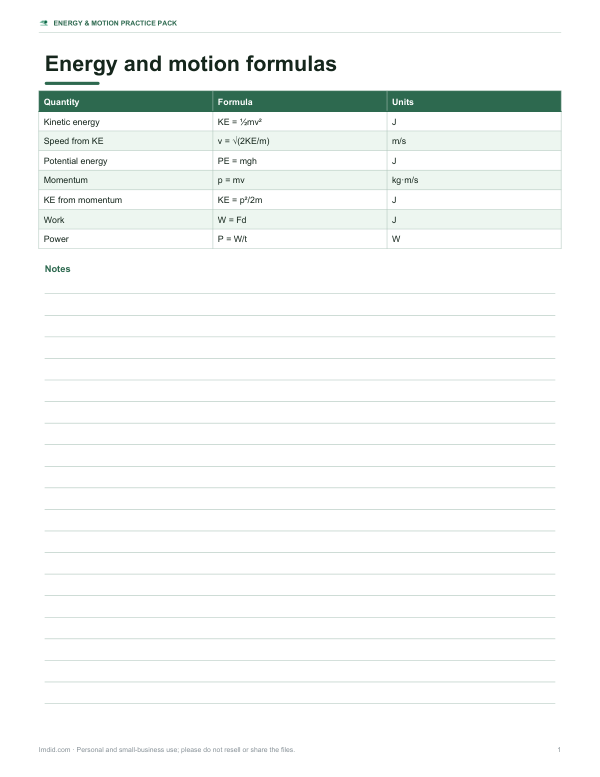
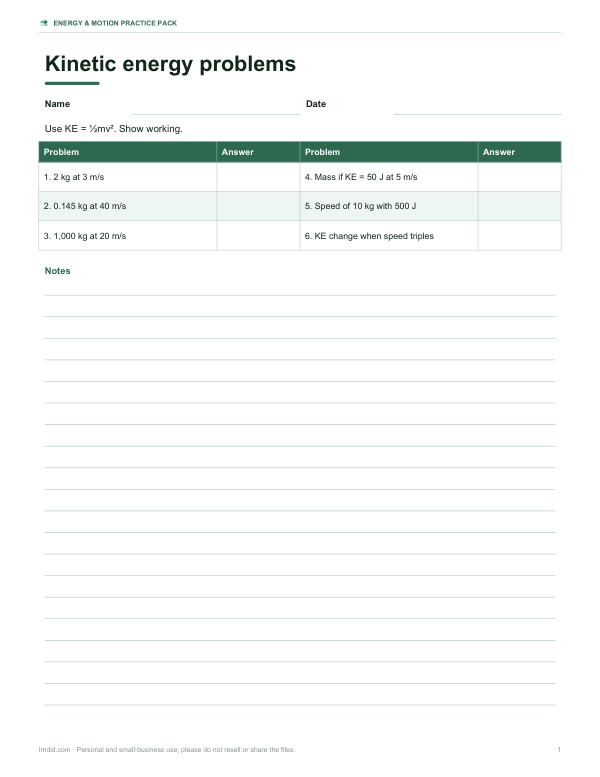
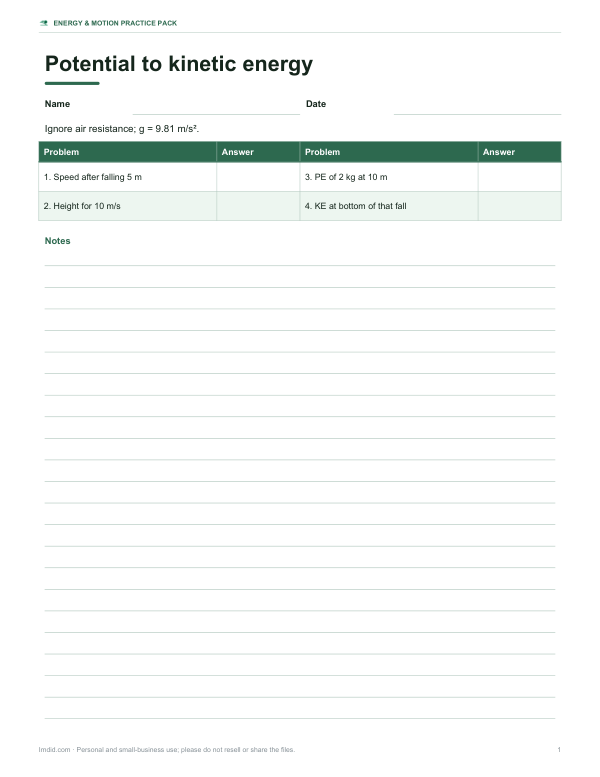
Printable physics practice: kinetic and potential energy formula sheet, two worksheets with worked answers, a unit conversion table and a lab data sheet for measuring speed and energy.
- Formula sheet (PDF)
- KE worksheet (PDF, DOCX)
- PE ↔ KE worksheet (PDF, DOCX)
- Lab data (XLSX)
Formats: PDF, DOCX, XLSX. Instant download after payment (link valid 72 hours, up to 5 downloads). AI-assisted: the templates were drafted with AI help and reviewed and laid out before publishing.
$5.00 USD, one-time 4 files · about $1.25 each
- Instant download
- 7-day refund
- Secure checkout by Stripe
7-day money-back guarantee. Full refund within 7 days of purchase, even after you download.
Free sample: Energy Conversion Worksheet (PDF, 95 KB)
Full refund within 7 days — see the refund policy and license.
Free printables
Single sheets you can print right now, no sign-up. The full pack adds every sheet in one download plus the editable files.
 Kinetic Energy Lab Data Sheet
The kinetic energy formula
Kinetic energy is the work needed to accelerate an object from rest to its current speed, and the work it can do while slowing down. For everyday speeds it is KE = ½mv², where m is mass in kilograms and v is speed in metres per second, giving energy in joules. Because speed is squared, doubling the speed quadruples the kinetic energy — the reason a small increase in driving speed makes collisions much more severe.
Rearranged formulas
| To find | Formula |
|---|---|
| Kinetic energy | KE = ½ m v² |
| Mass | m = 2 KE ÷ v² |
| Speed | v = √(2 KE ÷ m) |
| From momentum | KE = p² ÷ 2m |
| Work–energy theorem | Net work = ΔKE |
Everyday examples
| Object | Mass | Speed | Kinetic energy |
|---|---|---|---|
| Raindrop | 0.034 g | 9 m/s | ≈ 0.0014 J |
| Baseball pitch | 145 g | 40 m/s (90 mph) | ≈ 116 J |
| Person jogging | 70 kg | 3 m/s | 315 J |
| Cyclist + bike | 85 kg | 8 m/s | ≈ 2.7 kJ |
| Car in town | 1,500 kg | 50 km/h | ≈ 145 kJ |
| Car on the motorway | 1,500 kg | 100 km/h | ≈ 579 kJ |
| Loaded truck | 40,000 kg | 90 km/h | 12.5 MJ |
Figures are illustrative, calculated with KE = ½mv².
How to use the calculator
- Choose what to solve for: kinetic energy, mass or speed.
- Enter the two known values and pick their units — kg, g, lb or tonnes; m/s, km/h, mph or ft/s.
- Read the result in several units, plus momentum and the equivalent drop height.
- Change the speed to see how energy grows with its square.
Worked example
A 1,500 kg car at 100 km/h is travelling at 100 ÷ 3.6 = 27.78 m/s. Its kinetic energy is ½ × 1,500 × 27.78² ≈ 578,700 J, or about 579 kJ. At 50 km/h it has a quarter of that — about 145 kJ. To stop, the brakes must turn all of that energy into heat; the same energy would be gained by falling from about 39 metres, which is why high-speed crashes are so destructive.
Kinetic and potential energy
Energy changes form without disappearing. A ball dropped from height converts gravitational potential energy (mgh) into kinetic energy (½mv²); at the bottom, ignoring air resistance, mgh = ½mv², so v = √(2gh) — independent of mass. A pendulum swaps back and forth between the two. The “equivalent height” in the calculator uses this relationship.
Relativistic kinetic energy
At speeds approaching the speed of light, ½mv² underestimates the energy. The exact formula is KE = (γ − 1)mc², where γ = 1/√(1 − v²/c²). At 10% of light speed the classical formula is about 0.75% too low; at everyday speeds the difference is negligible. The calculator flags speeds where relativity matters.
Kinetic energy and road safety
Because kinetic energy rises with the square of speed, braking distance does too: at twice the speed a car needs about four times the braking distance, before adding the distance travelled during the driver’s reaction time. That is why a crash at 60 km/h involves 44% more energy than one at 50 km/h, and why small reductions in speed limits in towns have a large effect on injuries.
Where the energy goes
| Situation | Kinetic energy becomes |
|---|---|
| Braking a car | Heat in brake discs and pads |
| Regenerative braking (EVs) | Partly back into the battery as electrical energy |
| A ball hitting the ground | Sound, heat and deformation, with some bounce back |
| Wind turbine | Electrical energy from the moving air |
| Meteor entering the atmosphere | Heat and light |
Common mistakes
- Forgetting to convert km/h or mph to metres per second before using the formula.
- Using grams instead of kilograms — the result will be 1,000 times too large.
- Squaring the mass instead of the speed.
- Leaving out the ½.
- Adding kinetic energies of objects moving in different directions as if they were momenta — energy has no direction.
Rotational kinetic energy
Spinning objects also store kinetic energy: KE = ½ I ω², where I is the moment of inertia and ω is the angular speed in radians per second. A rolling wheel or ball has both translational and rotational kinetic energy, which is why a rolling solid ball reaches the bottom of a slope more slowly than a frictionless sliding block — part of its energy goes into spinning.
Units
| Unit | In joules |
|---|---|
| 1 kJ | 1,000 J |
| 1 calorie (small) | 4.184 J |
| 1 kilocalorie (food Calorie) | 4,184 J |
| 1 foot-pound force | 1.356 J |
| 1 kWh | 3,600,000 J |
Frequently asked questions
What is the formula for kinetic energy?
KE = ½mv² — half the mass times the speed squared.
What unit is kinetic energy measured in?
Joules (J) in SI units.
What happens to kinetic energy if speed doubles?
It becomes four times larger.
Can kinetic energy be negative?
No — mass is positive and speed is squared.
What is the difference between kinetic energy and momentum?
Momentum is mv (a vector); kinetic energy is ½mv² (a scalar).
How do I convert km/h to m/s?
Divide by 3.6: 100 km/h ≈ 27.8 m/s.
What is the kinetic energy of a 1 kg object at 1 m/s?
0.5 joules.
Is kinetic energy conserved in collisions?
Only in perfectly elastic collisions; in most collisions some becomes heat, sound and deformation.
Does a heavier object have more kinetic energy?
At the same speed, yes — kinetic energy is proportional to mass.
Why is speed more important than mass for kinetic energy?
Because speed is squared: doubling speed quadruples energy, while doubling mass only doubles it.
Is anything uploaded?
No, it runs in your browser.